
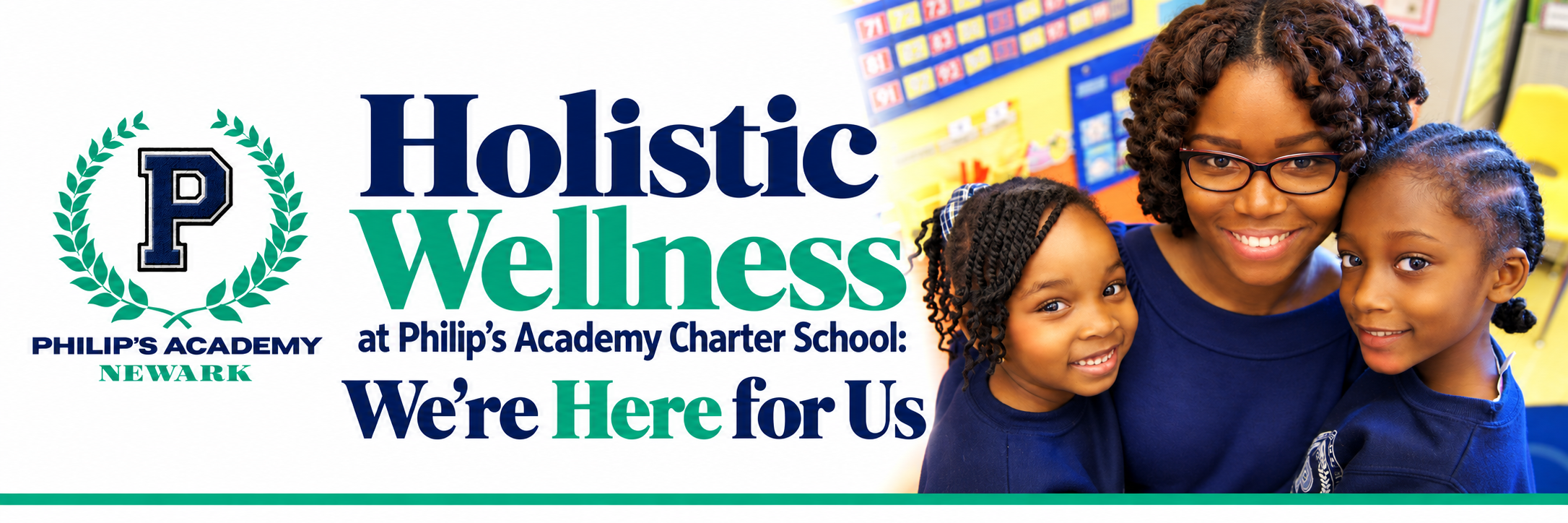
Nurturing the Whole Child: Philip’s Academy’s Approach to Holistic School Wellness
Over thirty-five years of serving Newark families has taught us a fundamental truth: children cannot thrive academically when their basic needs are out of balance. Long before school wellness became a national conversation, Philip’s Academy brought real-world health directly into the learning experience. Through our EcoSpaces program, students do not just read about nutrition in textbooks. They plant seeds in our rooftop garden, care for indoor hydroponic crops, and head into our teaching kitchen to prepare fresh meals from scratch. This hands-on immersion transforms how kids view what they eat. Academic research confirms that integrating school-based gardens and culinary education directly increases children's intake of fresh produce while boosting engagement and performance in core subjects like science and math (Berezowitz et al., 2015).
As our school grew, we realized that physical nutrition was only one part of the equation. True stability means giving young people the practical skills to navigate an increasingly complex world. That insight led us to embed everyday financial literacy into our lower school curriculum. Fourth graders—the student leaders on our lower school campus—take financial literacy four times a week. They learn to balance budgets, distinguish wants from needs, and shop for nutritious food on a budget—skills that ripple directly back to their households. Research shows that introducing practical money management to elementary students builds lasting financial understanding, encourages saving habits, and fosters smart decision-making that carries into adulthood (Batty et al., 2014).
Our vision continuously bridges classroom learning with home life. Through EcoSpaces @ Home, families receive culturally rich, budget-friendly recipes that use produce harvested straight from our gardens, turning healthy eating into a shared family experience. We pair this food culture with active, intentional physical and emotional development. Fourth grade marks our students' entry into competitive team sports, giving them a healthy outlet for building endurance, teamwork, and confidence. At the same time, our mental health initiatives destigmatize emotional well-being, providing students and parents with practical tools to manage stress and navigate life's challenges. Studies consistently demonstrate that regular physical activity and structured team sports improve cognitive function, focus, and overall academic performance in preadolescents (Chacón-Cuberos et al., 2020).
By bringing together nutrition, financial capability, emotional resilience, and active living, Philip’s Academy makes well-being a daily habit. We are building a public school model where every child gains the knowledge, life skills, and confidence to flourish both in the classroom and far beyond.
References
Batty, M., Collins, J. M., & Odders‐White, E. (2014). Experimental evidence on the effects of financial education on elementary school students' knowledge, behavior, and attitudes. Journal of Consumer Affairs, 49(1), 69–96.
Berezowitz, C. K., Bontrager Yoder, A. B., & Schoeller, D. A. (2015). School gardens enhance academic performance and dietary outcomes in children. Journal of School Health, 85(8), 508–518.
Chacón-Cuberos, R., Zurita-Ortega, F., Ramírez-Granizo, I., & Castro-Sánchez, M. (2020). Physical activity and academic performance in children and preadolescents: A systematic review. Apunts Educación Física y Deportes, (139), 1–9.